L'Univers FOODHUB · Guide · Wagyu
The Competition That Ranks Japan's Wagyu Prefectures
Every five years, Japanese breeders rank themselves against each other. In 2022 in Kagoshima: 41 prefectures, Kagoshima on breed, Miyazaki on meat.
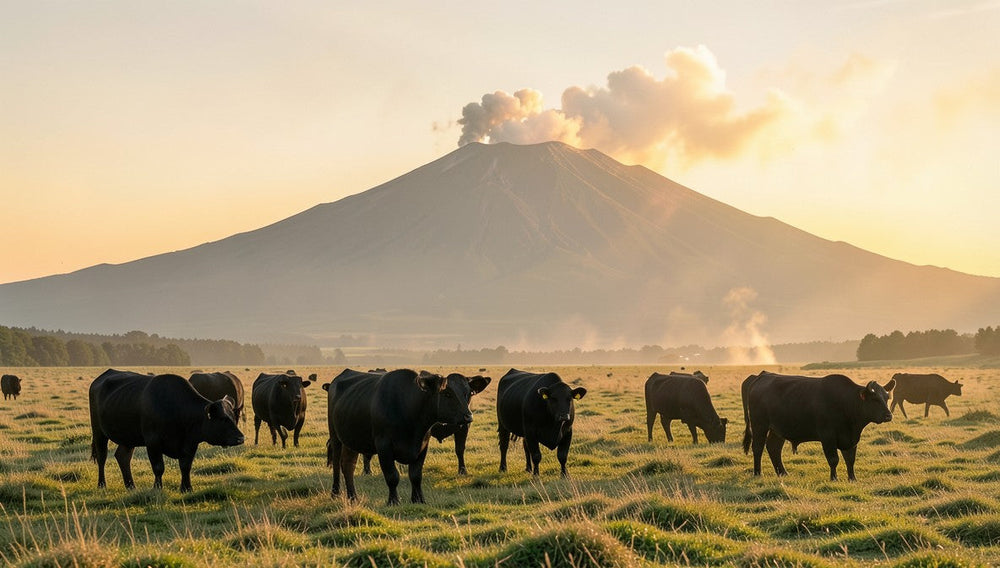
Every five years, Japanese breeders rank themselves against each other. The national Wagyu competition, the Zenkyō, is not a trade fair: it is a contest of genetics and meat quality whose results redraw the hierarchy of prefectures, and therefore prices. Here is why it should matter to you before you buy.

What the Zenkyō really is
Its full name is Zenkoku Wagyū Nōryoku Kyōshinkai. It is nicknamed the “Wagyu Olympics.” It is held once every five years, in a different host prefecture, and judges two main families of events: breeding animals, scored on conformation and genetic potential, and meat, scored on its quality.
In other words: on one side, the future of the herd; on the other, the result on the plate.
The 2022 edition: what happened
The twelfth edition was held from October 6 to 10, 2022, in Kagoshima Prefecture, in Kirishima. The figures give a sense of scale: 41 of Japan's 47 prefectures took part, with more than 400 animals competing and hundreds of thousands of visitors.
The result was a double win for the south of the country:
- Kagoshima won the Prime Minister's Prize for breed improvement, taking six of the nine categories. It was its second win in this event since 1992.
- Miyazaki took the title for meat quality, its specialty for several editions.
- Oita, also in Kyūshū, won one category.
A rare occurrence: the sitting Japanese Prime Minister attended the closing ceremony, a first for this competition.
Why Kyūshū dominates
Kagoshima, Miyazaki and Oita are neighbors in southern Japan. Three reasons explain their lead: a mild climate that allows long, steady rearing, large herds that broaden the available genetic base, and breeding programs funded by the prefectures themselves, for whom the competition is a major economic stake.
Because a win doesn't stay symbolic: it raises the profile of the regional brand, then demand, then export prices.

What the competition changes for buyers
Three concrete things.
- A benchmark independent of brands. The Zenkyō ranks prefectures on technical criteria, whereas the fame of a name like Kobe owes a great deal to its age.
- A price effect. After a win, demand rises. Buying from an excellent but less publicized prefecture often means paying less for equivalent quality.
- A read on genetics. The breeding-animal events foreshadow quality over the following five years: a prefecture that wins on breed today will deliver better cuts tomorrow.
And fat quality?
It is the rising criterion. Recent events have introduced the assessment of fat quality, notably the content of monounsaturated fatty acids, including oleic acid. This is what gives Wagyu its very low melting point and that melt-in-the-mouth sensation. Abundant marbling is no longer enough: the fat also has to be of the right kind.
Frequently asked questions
How often is the competition held?
Every five years. The twelfth edition was held in October 2022 in Kagoshima.
Who won in 2022?
Kagoshima for breed improvement, with six categories out of nine, and Miyazaki for meat quality.
Is Wagyu from a winning prefecture necessarily better?
No. The competition rewards the animals entered, not a prefecture's entire production. The grade and BMS score of the piece you buy remain the decisive benchmarks.
Why is it called the “Wagyu Olympics”?
Because the competition is held every five years, is national, and ranks prefectures like delegations. The nickname comes from the media, not the organizers.
Further reading
- Buying authentic A5 Wagyu: the guide
- Kobe or A5: one is an address, the other a grade
- Which Wagyu Cut for Which Cooking Method?
Our Wagyu from Kagoshima and Hokkaidō


Sources: J-LEC (Japan Livestock Products Export Promotion Council), The Japan Agricultural News, organizing committee of the 12th National Wagyu Competition.
Les coulisses, les arrivages et les recettes en vidéo :
@foodhubsupplyÀ lire aussi · Wagyu