L'Univers FOODHUB · Guide · Wagyu
Wagyu A5 vs Kobe: The Real Difference (Finally Explained)
A5 est une note de carcasse, Kobe une appellation de Hyōgo dont le persillage démarre à BMS 6. Ce que chacune garantit, le prix du nom, et les 4 vérifications qui démasquent un faux.
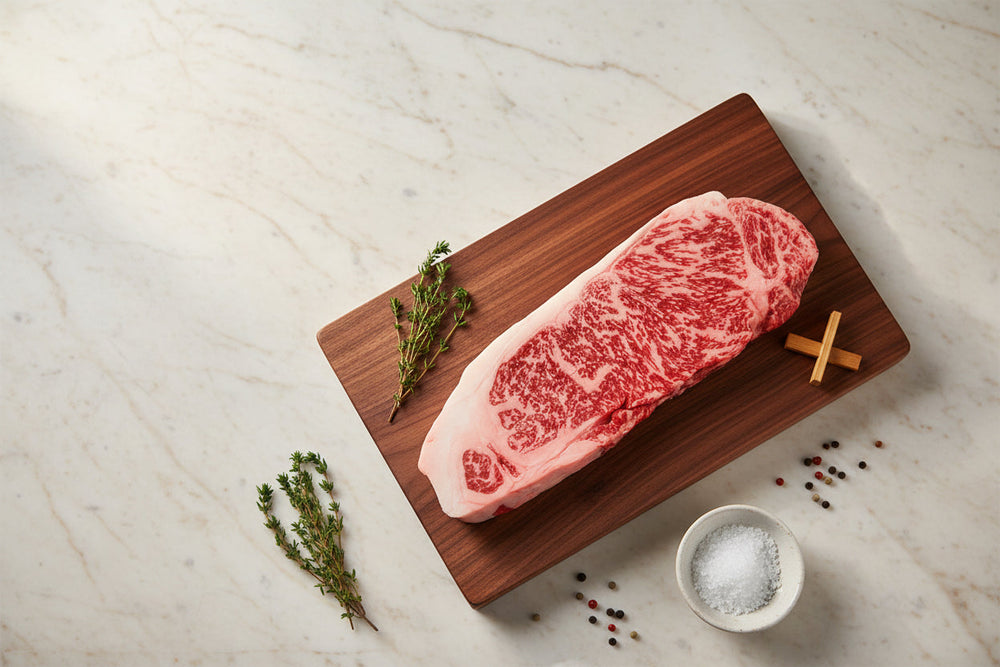
"Is it Wagyu or Kobe?" This question comes up with every tasting, and the answer is more subtle than it seems. Many people think Kobe and Wagyu are two different, even opposite, things. The reality: all Kobe is Wagyu, but not all Wagyu is Kobe. And the confusion fuels a parallel market of imitations that devalues the real product.
At FOODHUB, we exclusively work with A5 Wagyu directly imported from Japan. This guide definitively explains what distinguishes Wagyu from Kobe and how to ensure you're buying the real deal.
Wagyu: The Breed, Not the Origin
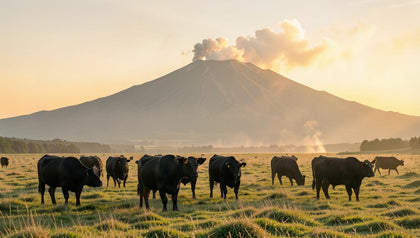
The word "Wagyu" (和牛) literally means "Japanese beef." It's the official name for four cattle sub-breeds raised in Japan for centuries:
- Japanese Black (Kuroge Washu), 90% of global Wagyu. The breed that produces the most extreme marbling.
- Japanese Brown (Akage Washu), a red breed from the Kumamoto and Kōchi regions. Leaner, more rustic meat.
- Japanese Polled (Mukaku Washu), a hornless breed, very rare (< 200 head).
- Japanese Shorthorn (Nihon Tankaku Washu), a northern breed, pasture-raised.
Wagyu is first and foremost a breed, not a region or a brand. What makes it unique is its genetics: the natural ability to develop exceptional intramuscular marbling (fat marbled within the muscle, not on the periphery).
The A5 Grading System: Understanding What You're Buying
Japan imposes an official grade on each Wagyu carcass, assigned by the Japan Meat Grading Association. The grade combines two dimensions:
The Letter (A, B, or C)
Measures the yield of the carcass, the percentage of usable meat. A is the best (yield ≥ 72%). C is the lowest. This letter does not concern taste quality, only the animal's productivity.
The Number (1 to 5)
Measures the meat quality based on four criteria: meat color, fat color, texture, and most importantly, BMS (Beef Marbling Standard). BMS is the key indicator: it evaluates marbling on a scale of 1 (low) to 12 (extreme).
- Grade 5: BMS 8 to 12, very intense to extreme marbling.
- Grade 4: BMS 5 to 7.
- Grade 3: BMS 3 to 4.
- Grade 2: BMS 2.
- Grade 1: BMS 1.
"A5" therefore designates a carcass with the best yield (A) and the best meat quality (5), representing the absolute pinnacle. Only 15 to 20% of Wagyu produced in Japan achieve this grade.
Kobe: The Protected Brand
"Kobe Beef" (神戸ビーフ) is a protected designation of origin, equivalent to a French PDO. It refers to meat that meets 7 strict criteria:
- Breed: Tajima-gyu (a sub-line of Japanese Black).
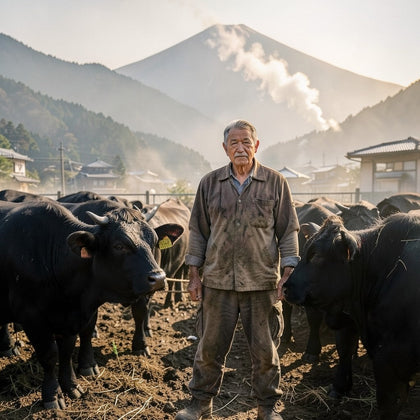
- Origin: raised in Hyōgo Prefecture (around Kobe city).
- Gender: castrated steer or heifer, never a bull or breeding cow.
- Quality grade: minimum grade 4 (i.e., A4 or A5, or B4/B5).
- BMS: minimum 6.
- Carcass weight: 270 to 499.9 kg.
- Individual identification number, traceable from birth to slaughter.
Only about 5,000 to 6,000 animals per year meet these criteria. By comparison, Japan produces about 500,000 Wagyu annually. Kobe therefore represents approximately 1% of Japanese Wagyu.
Wagyu vs. Kobe: Comparative Table
| Criterion | Wagyu (general) | Kobe |
|---|---|---|
| Nature | Japanese breed (4 sub-breeds) | Protected designation |
| Geographical Origin | Throughout Japan | Hyōgo Prefecture only |
| Authorized Breed | 4 sub-breeds | Tajima-gyu only |
| Minimum Grade | None | A4 / B4 or higher |
| Minimum BMS | None | 6 |
| Annual Volume | ~500,000 head | ~5,000 to 6,000 head |
| Average Price (Europe) | €120 to €600/kg | €400 to €900/kg |
Why A5 Wagyu (Non-Kobe) is Often a Better Buy
Kobe enjoys exceptional global notoriety, which comes with a brand premium (30% to 100% higher than equivalent A5 Wagyu). But in terms of pure taste quality, A5 Wagyu from Kagoshima, Miyazaki, or Hokkaido can match, or even exceed, the quality of an A4 Kobe. The famous Japanese national competitions in recent years have been won by breeders from Kagoshima and Miyazaki, not Hyōgo.
For home tasting, a Grade 5 A5 Wagyu from Kagoshima offers an incomparable quality-to-price ratio compared to Kobe. You get extreme marbling (BMS 8 to 12) without the appellation premium.
How to Know if You're Buying Real A5 Wagyu
1. The Individual Certificate
Each authentic Japanese A5 Wagyu carcass comes with a certificate indicating: individual identification number (10 digits), birth date, farm, abattoir, slaughter date, official grade, BMS. If the seller cannot produce this certificate, be wary.
2. "Origin Japan" Provenance
Beware of the "Wagyu" trap without further details. In the United States and Australia, breeders sell "Wagyu" which is actually just crossbred (Wagyu × Angus, Wagyu × Holstein), with proportions ranging from 50% to 90%. These products are not pure Japanese Wagyu. For authentic Wagyu, demand the mention "100% Wagyu, Origin Japan."
3. The Japanese Red Label
The official "JMGA" (Japan Meat Grading Association) label must appear on the invoice, label, or certificate. This is the ultimate guarantee.
4. Consistent Pricing
A5 Wagyu does not go below €120/kg on the importer side, and reaches €400 to €600/kg at retail for prime cuts (sirloin, ribeye). A "Wagyu A5" at €40/kg does not exist.
FAQ, A5 Wagyu and Kobe
Is Wagyu necessarily A5?
No. Wagyu comes in grades A1 to A5, B1 to B5, C1 to C5. Only A5 is considered the absolute pinnacle. An A4 is already excellent. Below that, marbling is less intense.
Can Kobe be produced in France or the United States?
No. The term "Kobe" is legally protected: only beef born, raised, and slaughtered in Hyōgo Prefecture according to the 7 strict criteria can be called Kobe. Any "Kobe-style" or "American Kobe" is a misleading commercial use; the product has no relation to true Japanese Kobe.
Is A5 Wagyu more tender than classic beef?
Much more tender, due to the extreme intramuscular marbling that "melts" at 25-30°C (compared to 40°C for the peripheral fat of classic beef). During cooking, the intramuscular fat liquefies, basting every muscle fiber, giving that characteristic melt-in-your-mouth sensation.
How much A5 Wagyu per person?
A5 Wagyu is so rich that you consume less of it. 80 to 100g per person for a tasting is sufficient, compared to 180 to 250g for a classic ribeye. This is also why the 2x100g format is so popular: the ideal portion for two.
How to cook A5 Wagyu?
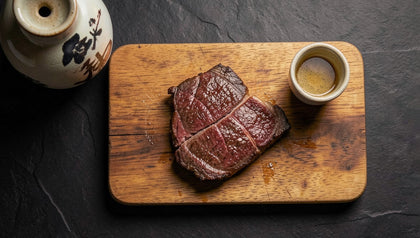
Quick and short sear. Hot pan, 60 to 90 seconds per side for a 1.5 cm slice, rest 3 to 5 minutes off the heat. No added fat, the meat provides its own. The complete A5 Wagyu cooking guide details all methods.
Available on FoodHub
Genuine A5 Wagyu, certified from Japan
🥩 A5 Wagyu Sirloin Vacuum-Sealed ±1.5kg€256.33 Add to cart →
Les coulisses, les arrivages et les recettes en vidéo :
@foodhubsupplyÀ lire aussi · Wagyu