L'Univers FOODHUB · Article · Vinaigre
Kakuida: two centuries of Japanese black vinegar
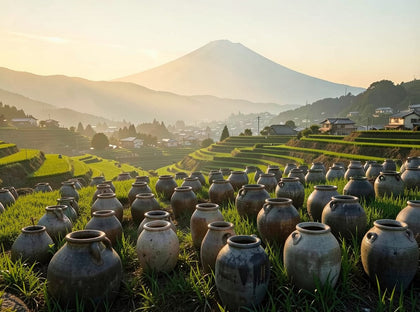
In Fukuyama, on Japan's southern peninsula, near Kagoshima, two hundred terracotta jars lined up in the sun have been producing Japan's most revered black vinegar since 1805. Kakuida, a house of seven generations of vinegar masters, perpetuates a tradition over two centuries old: the natural fermentation of kurozu, black brown rice vinegar.
At FOODHUB, we work directly with Kakuida to introduce this exceptional product to France. This portrait traces the history of a family, the science of their process, and the uniqueness of a terroir.
Fukuyama, the birthplace of Japanese black vinegar
The Fukuyama region benefits from a unique microclimate in Japan: exceptional annual sunshine (over 2,100 hours), low temperature fluctuations, and a constant wind from the sea. This climate allows for open-air fermentation, in earthenware jars exposed to the sun and air 365 days a year.
As early as the 18th century, several families settled in Fukuyama to exploit these natural conditions. Today, there are still about twenty traditional producers, but Kakuida is the only house that has preserved all of its ancient jar heritage.
The Kakuida family: seven generations of vinegar masters
The adventure began in 1805 with Sōzaburō Kakuida, a samurai who converted to vinegar production. He bought the land where the jars are now located and established the basics of the process, which has remained almost unchanged since then. His son, then his grandson, passed on the know-how.
In the 20th century, the family went through two world wars and Japan's forced modernization, without ever abandoning slow jar fermentation. While competitors switched to industrial production (stainless steel tanks, chemical accelerators), the Kakuida family stuck to their principles. It is this choice that today earns them their status as the absolute benchmark for Kurozu.
The current head, the seventh generation, leads a team of 12 people, including 3 heirs and 9 artisans trained on site for a minimum of five years. No mechanical tools are used in the fermentation: everything is done by hand, in direct continuity with the 19th century.
The "shizenjozo" process: natural jar fermentation
The word shizenjozo (自然醸造) means "natural brewing." It describes a process that involves no additives, no activators, and no artificial heat. Three steps:
1. Koji preparation (15 days)
Whole grain brown rice (unpolished) is steamed, then inoculated with the fungus Aspergillus oryzae in a dedicated room. For 48 hours at 30 °C, the koji develops. It will then be mixed with spring water and cooked rice in each jar.
2. Jar fermentation (6 months to 5 years)
Each terracotta jar receives its mixture of koji, rice, and water. Covered with a braided rice straw lid, it remains exposed to the open air, sun, and wind. Four fermentations follow one another in the jar:
- Saccharification: koji transforms rice starch into simple sugars (3 to 7 days).
- Alcoholic fermentation: wild yeasts present in the air transform sugars into alcohol (15 to 30 days).
- Acetic fermentation: acetic bacteria transform alcohol into acetic acid (3 to 6 months).
- Maturation: amino acids and aromatic compounds develop over a long period (6 months to 5 years depending on the vintage).
3. Filtering and bottling
After maturation, the vinegar is drawn from the bottom of the jar, naturally filtered through cloth, and bottled in dark brown bottles. No strong pasteurization, no additions: the final product is as close as possible to the raw material.
The 200 hand-turned jars, 4 times a day
Every morning, noon, afternoon and evening, the Kakuida artisans walk between the rows of jars to turn them a quarter turn. Why? Because the sun heats the jar unevenly depending on its orientation, which creates an internal convection current that maintains homogeneous fermentation.
This manual rotation, an seemingly anodyne gesture, is actually a critical intervention. It determines the uniformity of the final product. No machine can replace it because each jar, due to the artisanal clay, has a unique thermal signature.
The 4 iconic vinegars from the Kakuida house
Kurozu 3 years
The entry into the Kakuida world. 3 years of fermentation, amber mahogany color, mild acidity (4.2%), aromas of toasted hazelnut, licorice, and leather. Versatile: vinaigrettes, marinades, deglazings. Available in 500 ml bottle.
Kurozu 5 years
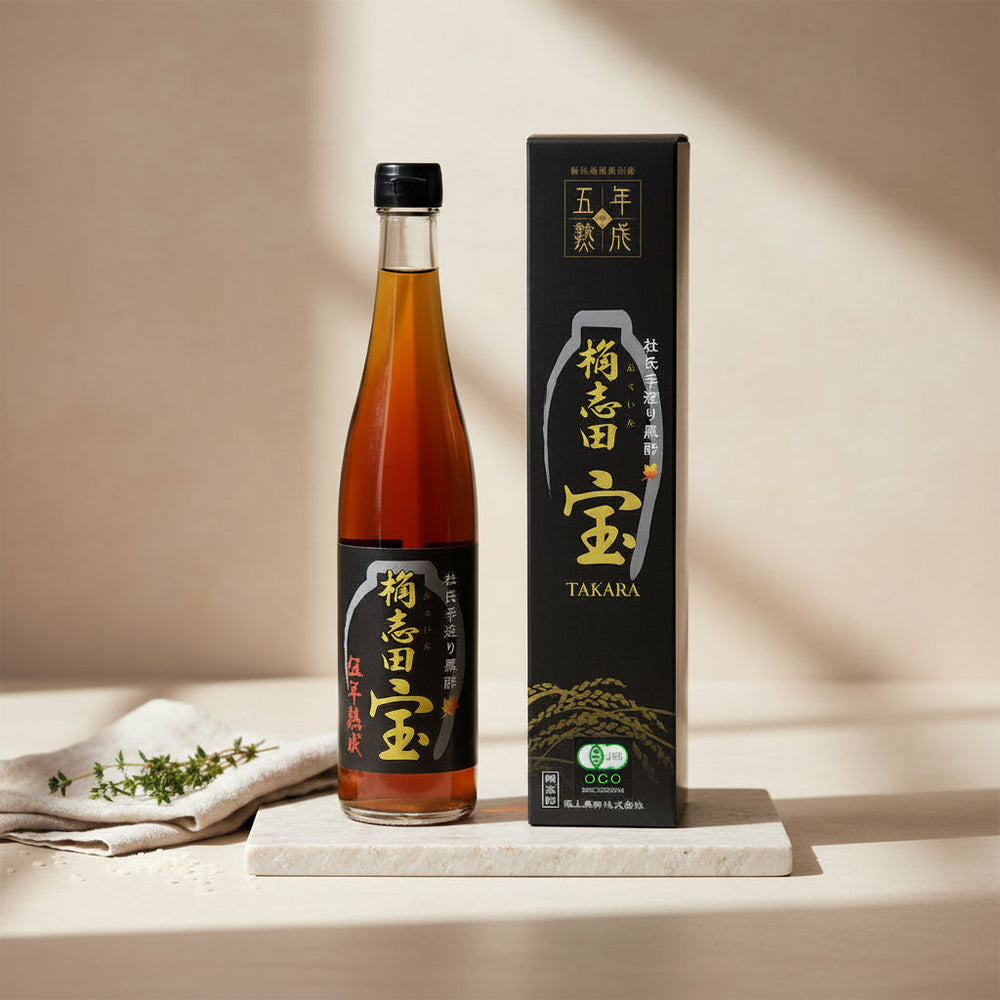
The absolute reference. 5 years of fermentation, almost black color, more complex aromas (cocoa, coffee, dried fruits). To be used as a raw finish (sashimi, carpaccio, sushi). Available in 500 ml bottle.
Kurozu in traditional pot
Special edition in a miniature terracotta jar, which continues to mature after bottling. For collectors and chefs.
Izumi (organic black vinegar)
Certified organic variant, pesticide-free, same ancestral methods. A gateway for enthusiasts sensitive to labels. Available in 720 ml.
Culinary uses: 6 immediate ideas
- Signature vinaigrette: 3 tablespoons Taggiasche olive oil + 1 tablespoon Kurozu 5 years + 1 teaspoon honey + fleur de sel. For seasonal salads, beetroot, duck breast.
- Wagyu marinade: 30 minutes before cooking, Kurozu 3 years + soy sauce + grated ginger. Deep caramelization in the pan.
- Deglazing: after cooking poultry, a dash of Kurozu deglazes the juices, creating an instant sauce.
- Healthy drink: 1 tablespoon of Kurozu in a glass of cold or warm water, first thing in the morning. Japanese tradition for digestion.
- Sashimi & sushi: replace traditional white rice vinegar in sushi rice with 50/50 rice vinegar + Kurozu, for incomparable depth.
- Reduction: reduce 100 ml of Kurozu over low heat until syrupy, enjoy with strawberries or goat cheese.
FAQ, Kakuida and Kurozu
Why is Kakuida Kurozu more expensive than other vinegars?
3 to 5 years of maturation in traditional jars, daily manual rotation, organic whole grain brown rice, filtered spring water. The yield is low (1 liter of vinegar for 4-5 kg of raw material), production is limited (a few thousand liters per year). It is an exceptional artisanal product, not an everyday vinegar.
How long does Kurozu keep?
An unopened bottle can be stored indefinitely, the vinegar does not spoil. Once opened, it is optimal for 2 to 3 years away from light. Some enthusiasts keep their Kurozu for more than 10 years: it continues to improve in the bottle (the color darkens, the aromas concentrate).
Kurozu vs balsamic vinegar: what's the difference?
Italian balsamic is made from cooked grape must, fermented in wooden barrels (oak, cherry, chestnut) for 12 to 25 years for traditional DOP. Kurozu is made from brown rice fermented in earthenware jars for 3 to 5 years. Balsamic is sweeter (concentrated grapes), Kurozu is deeper in umami (amino acids from fermented rice).
Can Kurozu be drunk directly?
Yes, diluted in water. In Japan, it is a traditional daily drink (with or without honey). Pure, it is concentrated (4.2% acidity): one tablespoon in a glass of water is enough.
Does Kurozu really have health benefits?
Several Japanese studies highlight its richness in essential amino acids, polyphenolic antioxidants, and melanoidins (brown pigments resulting from fermentation). Health claims vary by jurisdiction; in France, none are official. Kurozu remains first and foremost a great gastronomic product.
Available on FoodHub
Kakuida Vinegars, the black signature
🍶 Kurozu 5 Year Vinegar 500ml€55.55 Add to cart →
🍶 Kurozu 3 Year Vinegar 750ml€51.11 Add to cart →
⚱️ Kakuida 10 Year Vinegar, rare edition€256.37 Add to cart →
Les coulisses, les arrivages et les recettes en vidéo :
@foodhubsupplyÀ lire aussi · Vinaigre