L'Univers FOODHUB · Article · Huile
Ardoino: Liguria as the religion of the Taggiasca olive
On the Ligurian coast, between San Remo and the French border, a family has been producing what many consider to be one of the finest Italian olive oils since 1870: Ardoino. Five generations of the Isnardi family have made the Taggiasca olive their religion. A demanding, almost obsessive religion, which today produces exceptional oils, sought after by Michelin-starred chefs across Europe.
At FOODHUB, we work directly with Ardoino oils. This profile tells a story of terroir, patience, and a very particular olive that grows only on the hills of Liguria.
Imperia, Liguria's olive oil capital
Liguria is the smallest olive oil producing region in Italy: barely 4,000 hectares planted, compared to 200,000 in Tuscany and 350,000 in Puglia. But this quantitative modesty hides a unique singularity in the world. The Ligurian Riviera is the only area in the Mediterranean where the Taggiasca olive thrives, an indigenous variety with inimitable characteristics: small size, delicate flesh, exceptional sugar-acidity balance.
Imperia, the economic capital of the province, has hosted mills that transform this olive into oil since the Middle Ages. The Isnardi family settled there in 1870, five years before the definitive unification of Italy. Four generations of olive growers have patiently built a brand that today dominates the premium segment.
The Isnardi family: 150 years of continuity
The founder, Giuseppe Isnardi, opened his first mill in 1870 in the port district of Imperia. He passed it on to his son Pietro, who structured the company by distinguishing two ranges: "Ardoino" for high-end, kept under the family name "Isnardi" for everyday cooking oils. This segmentation is today the standard in the industry; Isnardi invented it.
The next three generations consolidated the company, overcame two world wars, and gradually integrated modernity (centrifugation, analytical quality control, PDO certifications) without ever abandoning manual fruit selection.
Today, the fifth generation manages the company from the historic mill in Imperia. Thirty people work full-time. Production remains limited: approximately 1,500 tons annually, which places Ardoino in the artisan category (compared to industrial groups that produce 50,000 to 100,000 tons per year).
The Taggiasca: portrait of a unique olive
The Taggiasca olive (named after the medieval village of Taggia) has several peculiarities:
- Small size: 1 to 1.8 grams. Much smaller than Picholine or Coratina.
- Delicate, not very juicy flesh: which explains the low yield (10 to 13% oil vs 18-22% for southern varieties).
- Late and extended ripening: harvesting extends from October to February, allowing for differentiated cuvées ("early harvest" oil being greener, "late" being sweeter).
- Unique aromas: green almond, artichoke, pine nut, slightly sweet finish. No aggressive bitterness, no excessive pungency.
- Low yield: it takes 8 to 10 kg of olives to produce 1 liter of oil (compared to 5 kg for Coratina). This is one of the reasons for the price.
This olive represents the absolute opposite of the intense oils from the South (Coratina from Puglia, Picholine from Languedoc). Where these strike with their power, the Taggiasca convinces with its subtlety. It is the oil for fish, white vegetables, delicate raw sauces, steamed meats. A "French" oil in its refinement, Italian in its terroir.
The Ligurian terroir: altitude, winds, soils
The Ligurian olive groves are terraced on the flanks of the Maritime Alps, between the sea and the mountains. Three factors define their uniqueness:
Altitude
Between 200 and 800 meters. At this height, the day/night temperature differences develop the complex aromas of the Taggiasca. The highest olive groves (above 500 m) produce the finest oils.
Winds
The mistral in winter, the sea breeze in summer. The wind naturally cleanses the trees and limits diseases, leading to very reduced use of phytosanitary treatments.
Soils
Clay shales and limestones, on millennial terraces bordered by dry stone walls. This structure allows for perfect drainage: the olive tree never suffers from excess water, which concentrates the aromas in the fruit.
Hand-picking, early November
Harvesting begins in early November and continues until January. At Ardoino, it is done exclusively by hand, using vibrating combs or by direct picking. Nets are spread under the trees to collect the olives as they fall, never picked from the ground (immediate oxidation).
The olives are taken to the mill within six hours of picking. This is a constraint that few manufacturers respect (the norm is 24 to 48 hours). This speed preserves volatile aromatic compounds and prevents the start of internal fruit fermentation.
The iconic oils of the Ardoino house
Drupa Aurea, the golden olive
The signature cuvée. Olives harvested mid-ripeness, cold extracted within 24 hours. Intense aromas of fresh artichoke, green almond, cut grass. Free acidity 0.2%, high polyphenols. For informed amateurs who appreciate an expressive oil. Available in an opaque bottle.
Argento, elegance
The "everyday premium" range. Harvested at full ripeness, rounder, less distinctive profile. Ideal for gentle cooking and balanced vinaigrettes.
Vallaurea
Single-parcel selection, vinification of olives from a single historic terrace. Confidential production. The rarest of Ardoino oils, available in limited edition.
Novello, the new oil
Bottled immediately after extraction, without decantation. Natural veil, maximum aromas. To be consumed within 6 months. Available seasonally.
How to taste them: temperatures and pairings
Serve at room temperature
Never taken out of the refrigerator, oil "contracts" in the cold. Take the bottle out 30 minutes before use.
Pure tasting mode
A few drops on still warm white bread, or on fresh buffalo mozzarella, or on beef carpaccio. The purity of Taggiasca then reveals its full potential.
Food and oil pairings
- Raw & cooked fish: Drupa Aurea reveals white fish without overpowering it.
- Steamed vegetables: artichokes, asparagus, fennel, total affinity with Taggiasca.
- Burrata, mozzarella: a drizzle is enough to transform an ordinary product into a moment of grace.
- Traditional Ligurian pesto: Taggiasca is the mandatory oil for true pesto, not Tuscan.
- Wagyu carpaccio: the umami of beef meets the subtlety of green almond.
FAQ, Ardoino and Taggiasca
Why is Taggiasca olive oil more expensive?
Low yield (10-13% vs 20% for other varieties), 100% manual harvesting, restricted terroir (Liguria only), limited production. For 1 liter, 8 to 10 kg of olives are needed, while 5 kg are enough for other oils. It is intrinsically a prestige product.
Taggiasca PDO or PGI: what's the difference?
The PDO Riviera Ligure requires: 100% Taggiasca variety, olive grove in Liguria, manual harvesting, extraction within 24 hours, acidity ≤ 0.5%. This is the highest level of guarantee. PGI is more flexible. Ardoino offers both designations depending on the cuvées.
How to know if a "Taggiasca" oil is authentic?
Check for: PDO Riviera Ligure (official label), the mention "100% Taggiasca" (no blending), Ligurian origin (not vague "Italy"), harvest date (the most recent), opaque bottle (light degrades in a few weeks). A "Taggiasca" oil without PDO and without vintage is suspect.
How long does Ardoino oil keep?
18 months after harvest, unopened. 2 to 3 months once opened. Essential storage away from light, in a cool place (15-18°C ideal), stopper re-sealed. Quality Taggiasca oils retain their aromas longer than intense oils, which is one of the advantages of the variety.
Can Ardoino be used for cooking?
Yes, Taggiasca is very heat resistant up to 180°C. But it is so delicate that using a great Drupa Aurea to sauté onions is a waste of its aromas. Reserve the grand crus for raw use (carpaccio, salad, finishing), use a less prestigious cuvée for cooking.
Available on FoodHub
Italian olive oils, FoodHub selection
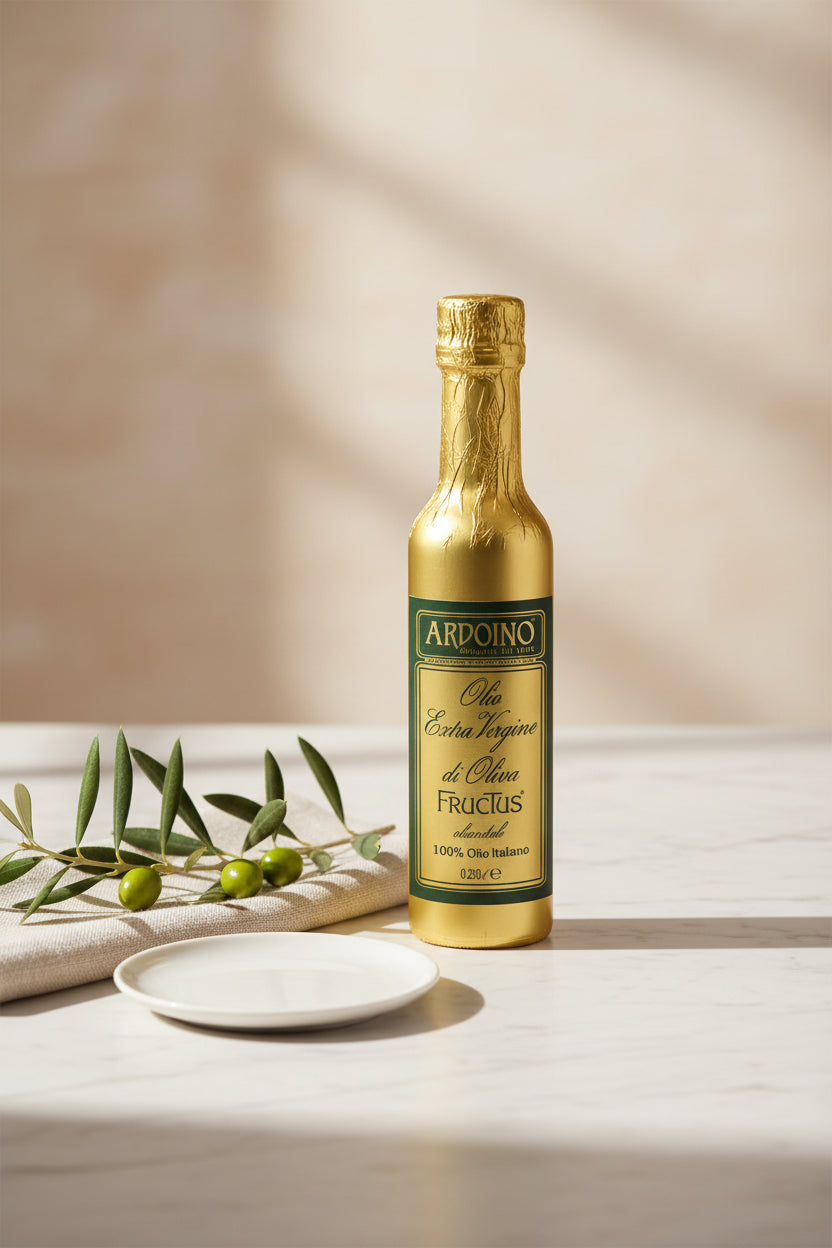
🫒 Fructus 100% Italian extra virgin olive oil€9.26 Add to cart →
Les coulisses, les arrivages et les recettes en vidéo :
@foodhubsupplyÀ lire aussi · Huile