

L'Univers FOODHUB · Article
How to choose your Italian olive oil: the complete guide
 Italian olive oil is a global benchmark, but also a category where it's easy to get lost. Between regions, olive varieties, PDO and PGI labels, and mentions of "extra virgin" and "cold pressed," how do you know what you're really buying? This comprehensive guide gives you all the keys to choosing an Italian olive oil that lives up to your dishes and your budget.
At FOODHUB, we select Italian oils directly from producers, from Liguria to Sicily. Here's the method we use ourselves to distinguish a great oil from a simple "olive oil."
Why Italy is an olive oil benchmark
Italy is the second largest olive oil producer in the world after Spain, but it remains the leader in diversity. There are over 500 indigenous olive varieties—an unparalleled heritage. Each region has developed, over centuries, its own olive cultivars, extraction methods, and taste profile. This mosaic explains why two Italian oils can be as different as a Burgundy wine and a Sicilian wine.
Practical consequence: there isn't "one" Italian olive oil, but distinct families of oils. Choosing well means first knowing what profile you're looking for.
Major Italian producing regions
Terroir—altitude, climate, soil, olive variety—shapes the taste much more than the brand. Here are the regions to know.
Liguria and the Taggiasca olive
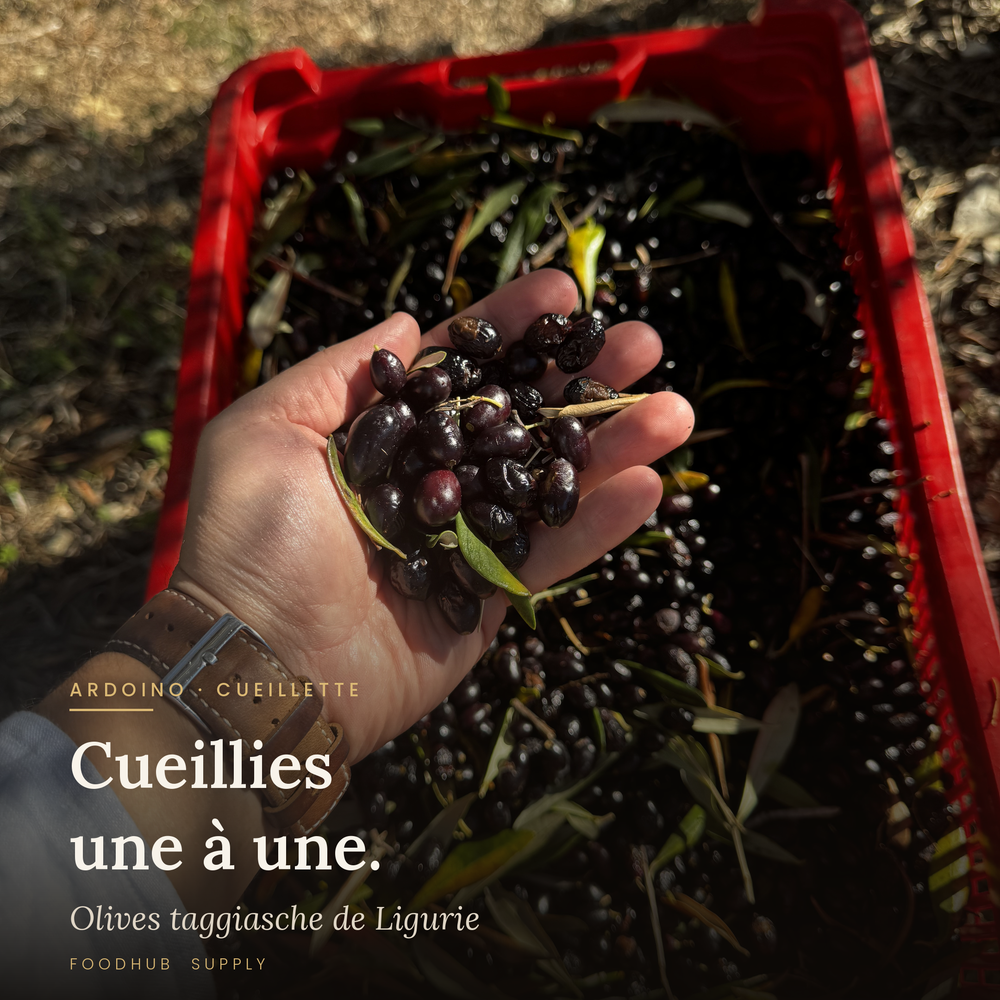
Italy's smallest producing region (barely 4,000 hectares), but one of the most unique. The Ligurian Riviera is the only area in the world where the Taggiasca olive thrives: small in size, fine flesh, remarkable sugar-acidity balance. The result is a sweet and delicate oil, with aromas of green almond, artichoke, and pine nut, without aggressive bitterness or excessive pungency. It's the oil for fish, white vegetables, and raw sauces. To learn more, read our portrait of the Ardoino house, a Ligurian reference since 1870.
Tuscany
With its Frantoio, Moraiolo, and Leccino varieties, Tuscany produces fruity and structured oils, with a clear bitterness and distinct pungency in the throat—signs of an oil rich in polyphenols. Perfect for grilled meat, vegetable soup (the famous ribollita), or bruschetta.
Puglia
Italy's largest production basin (350,000 hectares), home of the Coratina, one of the most potent olives in the world: an intense, very green, bitter, and pungent oil, suited for dishes with strong character.
Sicily and Lake Garda
Sicily (Nocellara, Biancolilla, Cerasuola varieties) offers aromatic, fresh, herbaceous oils, often with notes of tomato and almond. Geographically opposite, the shores of Lake Garda, thanks to an almost alpine microclimate, produce some of Italy's mildest and most delicate oils—similar in spirit to the Ligurian Taggiasca.
Understanding labels: PDO, PGI, and organic
Labels are not just marketing: they are legal guarantees of origin and method. Knowing how to read them changes everything.
DOP / PDO: the strictest origin
The DOP (Denominazione di Origine Protetta, Italian equivalent of the French AOP) guarantees that olives are grown and pressed in a specific area, according to controlled specifications (authorized varieties, maximum yield, acidity...). This is the highest level of traceability. Examples: DOP Riviera Ligure, DOP Toscano, DOP Terra di Bari.
IGP / PGI: broader origin
The IGP (Indicazione Geografica Protetta) is a step below the DOP: at least one stage of production (cultivation, processing, or preparation) takes place in the designated geographical area. This is the same principle as for Modena PGI balsamic vinegar, whose reputation rests precisely on this protection. A PGI remains a guarantee of quality.
"100% italiana" and the blend trap
Beware: an oil can be bottled in Italy while being produced from olives from several countries. The mention "100% Italian" (or "100% italiana") guarantees an entirely Italian origin. This is an essential reference point for our Fructus oils, which explicitly bear this label.
The organic label
The Euroleaf logo certifies cultivation without pesticides or synthetic fertilizers. It combines very well with a PDO or PGI—the organic Drupa Aurea from pitted olives is a good example.
The quality pyramid: extra virgin, cold pressed, acidity
Three technical mentions distinguish an exceptional oil from an ordinary one.
Extra virgin: the top category. The oil is obtained only by mechanical processes (without solvents or refining) and its free acidity is less than 0.8%. Below this, you'll find "virgin" (up to 2%) then "olive oil" (refined, with no gustatory interest). Always aim for extra virgin.
Cold pressed / extraction: the oil is extracted at a temperature below 27°C, which preserves aromas and polyphenols. A crucial mention, which we detail in our cold pressed guide.
Acidity: the lower, the better. A great oil often has an acidity well below the legal threshold of 0.8% (0.2 to 0.4% for the best). This figure has nothing to do with "acidic" taste: it measures the degradation state of fats.
Mild or robust? Choosing according to your dishes
The most useful criterion for everyday use: intensity. There are three main profiles.
- Mild / light (Ligurian Taggiasca, Lake Garda): for fish, seafood, steamed vegetables, delicate mayonnaise and raw sauces, pastries. The oil enhances without overpowering.
- Medium / fruity (Tuscany, Sicily): versatile for salads, bruschetta, pasta, roasted vegetables.
- Intense / robust (Coratina from Puglia): grilled meats, dried vegetable soups, dishes with strong character that can handle bitterness and pungency.
A chef's tip: keep two oils at home. A cooking oil (medium, in a can) and a finishing oil (extra virgin from a specific region, raw, at the end of cooking). To vary the pleasures, olive oil and lemon preparations or orange preparations from Fructus add an immediate aromatic note to fish or salad.
Regarding pairings, a mild Ligurian oil goes perfectly with a few drops of Modena PGI balsamic vinegar on burrata or tomato; the sweet-acid contrast of the balsamic complements the roundness of the Taggiasca.
Recognizing a truly exceptional oil
Unfortunately, the olive oil sector is one of the most fraudulent in the world. Here are some guidelines to avoid mistakes:
- The container: quality oil is sold in a dark bottle (tinted glass or metal can) that protects it from light. Avoid clear glass displayed on shelves.
- The date: prefer oil from the latest harvest. The harvest date (vintage) is a better indicator than just the best-before date.
- The price: a true extra virgin regional oil cannot cost just a few euros per liter. Taggiasca, for example, requires 8 to 10 kg of olives per liter—a low yield that justifies its price.
- Tasting: a great oil has fruitiness (grass, almond, artichoke), a slight bitterness, and a peppery sensation in the throat. These two "defects" are actually markers of polyphenols.
Can extra virgin olive oil be used for cooking?
This is one of the most persistent misconceptions: "olive oil cannot withstand cooking." This is false. A good extra virgin olive oil has a smoke point between 190 and 210°C—more than enough for a stir-fry, roasted vegetables, or slow cooking. Its richness in antioxidants even makes it more stable at high temperatures than many refined oils.
The real nuance is economic and gustatory: it would be a shame to heat a finishing oil from a specific region too strongly, as its finest aromas disappear with cooking. The common-sense rule: a medium oil for cooking, a characterful extra virgin for raw seasoning and finishing dishes. Reserve frying (above 210°C) for dedicated oils, but for 90% of your daily cooking, a good Italian olive oil works perfectly.
Last point: do not reuse oil that has smoked. The smoke point marks the beginning of degradation; beyond that, the oil loses its qualities and develops undesirable compounds. It's better to cook at a controlled heat than very high.
Properly storing your olive oil
An exceptional oil degrades quickly if stored incorrectly. Three enemies: light, heat, and air. Store it in a cupboard, away from light, far from cooking hobs, and close it tightly. Ideally, consume it within 12 to 18 months after harvest and within 2 to 3 months after opening to enjoy all its aromas. Avoid the refrigerator (the oil solidifies and can lose its finesse).
FOODHUB's olive oil selection
We offer a range of Italian oils chosen for their traceability and taste profile, with a strong Ligurian signature centered around the Taggiasca:
- Fructus organic 100% Italian extra virgin olive oil, 25 cl and its 50 cl format: everyday Ligurian sweetness.
- Drupa Aurea organic, from pitted olives: a high-end extraction, all in finesse.
- Taggiasca olives in brine and Taggiasca olive pulp to extend the Ligurian terroir to your plate.
Discover the entire FOODHUB olive oil collection to compare regions and intensities.
FAQ: Choosing your Italian olive oil
What is the best Italian olive oil?
There is no "best" oil in absolute terms: it all depends on the use. For finesse (fish, vegetables, raw), a mild Ligurian Taggiasca is unbeatable. For character (meats, soups), a Tuscan or a Coratina from Puglia is essential.
What is the difference between PDO and PGI?
PDO requires that cultivation and processing take place in the specified area, according to strict specifications. PGI requires that at least one stage takes place there. PDO therefore offers the strongest traceability; PGI remains a serious guarantee.
Is "extra virgin" enough to guarantee quality?
It's necessary but not sufficient. Also check for "cold pressed," low acidity, a dark bottle, and, ideally, 100% Italian origin with a recent harvest date.
Mild or robust oil to start with?
A mild and balanced oil (like Taggiasca) is the most versatile and easiest to appreciate. You can then explore more intense profiles depending on your dishes.
How long does olive oil keep?
12 to 18 months after harvest if stored properly (away from light and heat), and 2 to 3 months after opening for full aroma.
Our olive oils to add to your cart

Fructus 100% Italian Organic Oil, 25 cl
€9.26

Fructus 100% Italian Organic Oil, 50 cl
€17.90

Drupa Aurea Organic, pitted olives
€18.64

Fructus Citrus, lemon oil 25 cl
€13.71
Les coulisses, les arrivages et les recettes en vidéo :
@foodhubsupply


